 HAVE ANY QUESTIONS?
 15 YEARS OF EXPERIENCE

Your garage door won’t open; it is already dark outside, and your first thought is probably, “What happened?” Maybe you just pulled into the driveway after work, or you need to get the car out of the garage early the next morning. Opening failures feel even more inconvenient during November in Des Moines, when sunsets arrive earlier and cold evenings make standing outside troubleshooting the last thing anyone wants to do.
The good news is that not every garage door stuck closed means a major repair. Sometimes the opener lost power, the remote battery died, or a control setting changed. In other cases, the door cannot lift because a spring or another mechanical part has failed.
The safest approach is to check the simple causes first without forcing the door. These five steps can help you narrow down what happened and decide what information to give a garage door technician.
Garage Door Won’t Open? Start With These 5 Safe Checks
You do not need tools to perform these checks. Stay away from springs, cables, and moving parts while you work through the list.
1. Check Whether the Garage Door Opener Has Power
Start with the opener itself. Look at the opener unit mounted near the ceiling. Do its lights come on? Does the wall control respond? Can you hear any sound when you press the button?
If the opener appears completely dead, check whether it remains plugged into the outlet. You can also look at the home’s circuit breaker to see whether the garage circuit has tripped.
Some garages have a GFCI-protected outlet that can interrupt power after an electrical issue. If you know where the appropriate reset is and can reach it safely, check whether it has tripped.
A garage door power failure may explain the problem when:
- The opener has no lights
- The wall control does nothing
- The remote does nothing
- You hear no motor sound at all
If power returns and the opener operates normally, you may have found the issue. If it repeatedly loses power, the electrical problem deserves further inspection.
2. Test the Wall Control Instead of the Remote
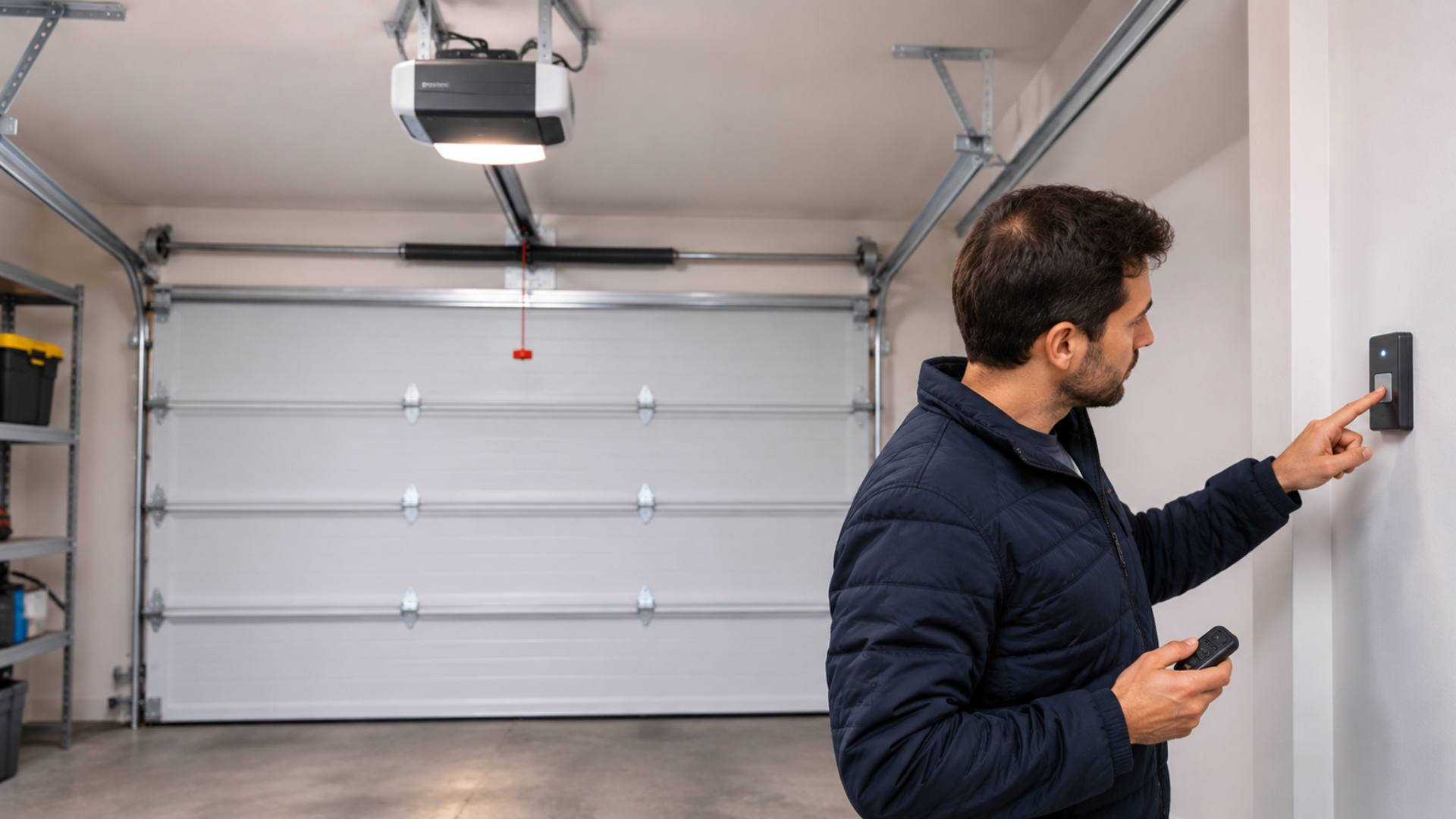
Next, try operating the door from the wall-mounted control inside the garage. If the wall button works but the handheld remote does not, the door itself is probably capable of opening. The problem may involve the remote battery, programming, or signal rather than the lifting system.
Replace the remote battery if you have the correct type available. Then test the remote again from inside or close to the garage. Also check whether another household remote works.
This quick comparison can save time:
| What Works | What It May Point To |
|---|---|
| Wall button works, remote does not | Remote battery or remote issue |
| One remote works, another does not | Problem with one remote |
| Wall control and all remotes fail | Power, opener, or mechanical issue |
| Opener makes noise, but door stays closed | Possible lifting or opener problem |
If your garage door opener is not working from any control, move to the next check rather than repeatedly pressing the button.
3. Check the Wall Control for Lock or Vacation Mode
Many garage door openers have a lock feature that disables handheld remotes. Homeowners sometimes activate it accidentally while pressing another button on the wall control.
Look at your wall control for a lock button, vacation mode, or indicator light. The exact design varies by opener model. When lock mode is active, the wall control may still operate the door while the remotes appear completely dead.
If you recently cleaned around the wall button, had guests over, or pressed the controls without looking closely, this simple setting is worth checking. Consult the opener manual if you are unsure how the lock feature works. Avoid randomly holding buttons down, since different models use different programming steps.
4. Make Sure the Door’s Manual Lock Is Not Engaged
Some garage doors have a manual slide lock or handle lock on the door itself. If someone engages that lock and then tries to operate the electric opener, the opener may pull against a door that physically cannot move.
From inside the garage, visually check whether a manual lock is engaged before trying the opener again. However, do not keep pressing the remote if the opener hums, strains, or pulls against a locked door. Continuing to operate it can put unnecessary stress on the opener and door hardware.
If your home normally relies only on the opener and you never use the manual lock, this problem may be unlikely. Still, it takes only a few seconds to rule it out.
5. Listen to the Opener and Look at the Spring From a Safe Distance
The sound the opener makes can tell you a lot. Press the wall control once and listen. Does the motor run while the garage door won’t lift? Does it start and then stop? Do you hear a hum but see almost no door movement?
Then look above the garage door from a safe distance if your system uses a torsion spring. A visible gap in the spring may indicate a broken garage door spring. Do not touch the spring or cables.
When a spring breaks, the opener may still run, but it no longer has the spring system providing the lift support it expects. The door can feel extremely heavy, and forcing the opener to keep trying may damage the motor or other components.
If you heard a loud bang earlier and the door now refuses to rise, a broken spring becomes an especially important possibility.
Quick Diagnosis: What the Opening Failure May Mean
Once you complete the five checks, compare what you noticed with these common patterns.
| What Happens | Possible Cause |
|---|---|
| Opener has no power at all | Outlet, breaker, or electrical issue |
| Wall control works, but remote does not | Remote battery, programming, or signal issue |
| Remotes stop working, but wall control works | Lock/vacation mode or remote issue |
| Opener strains against the door | Manual lock or mechanical resistance |
| Motor runs, but door barely moves | Spring or lifting-system problem |
| Door became very heavy suddenly | Possible broken spring |
| Opener hums and repeatedly stops | Opener or mechanical failure |
This is not a substitute for diagnosis, but it gives you useful information before scheduling garage door repair in Des Moines.
What Not to Do When the Garage Door Is Stuck Closed
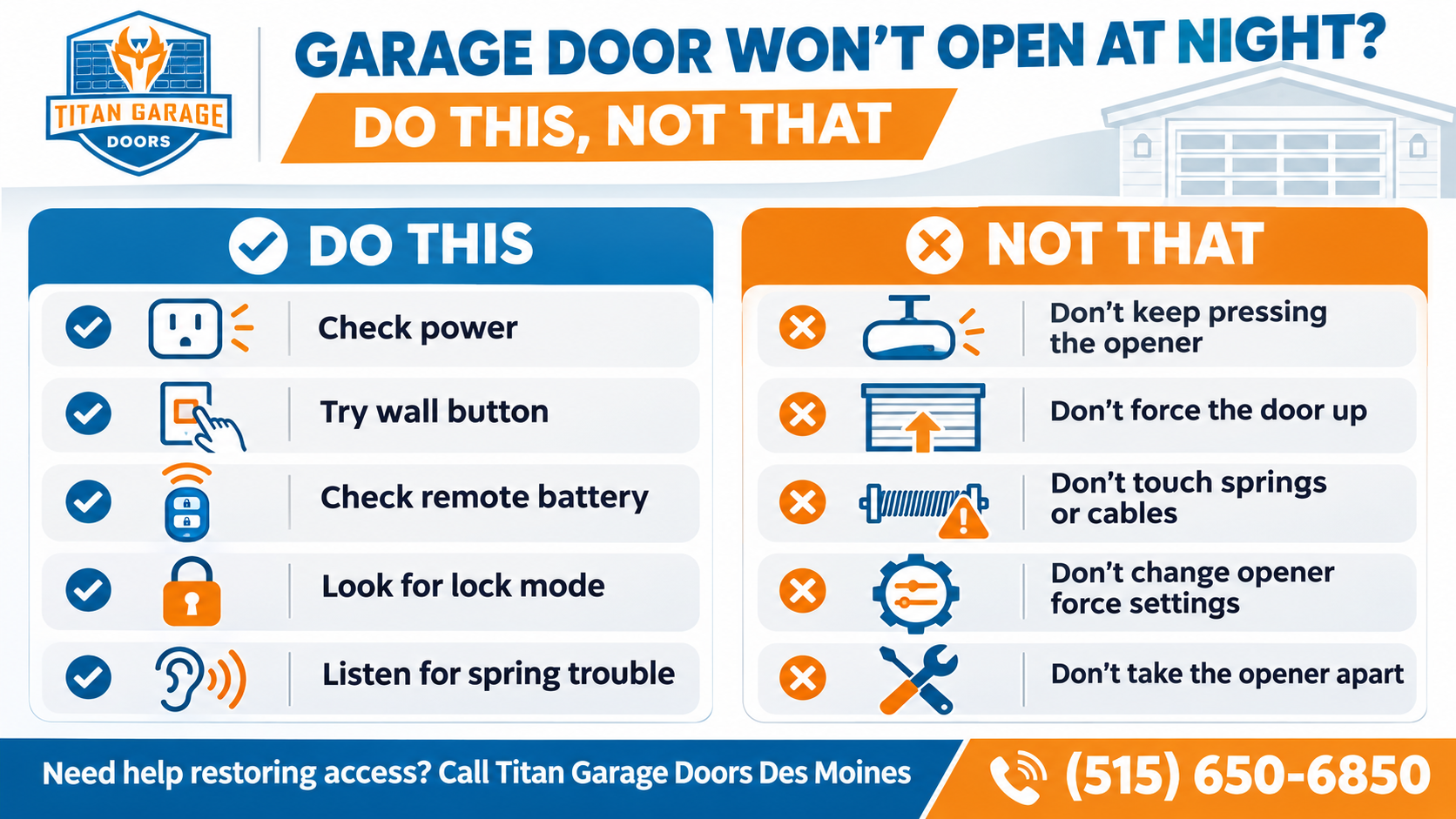
Once the simple checks fail, forcing the system usually creates more risk than progress. Avoid:
- Repeatedly pressing the opener button
- Pulling or adjusting springs
- Handling garage door cables
- Trying to lift a door that feels unusually heavy
- Increasing the opener’s force setting
- Taking apart the opener motor
- Prying the door upward with tools
- Disconnecting components because the motor will not lift the door
A garage door can weigh hundreds of pounds. The spring system normally makes that weight manageable, so a door that suddenly becomes much heavier deserves caution. The goal after hours is to restore access safely, not to turn one failed part into several damaged parts.
Cold Weather Can Expose a Garage Door Opening Problem
Cold weather does not automatically cause every garage door failure, but it can make an existing weakness more noticeable.
A door that already had added resistance may become harder for the opener to move. Older opener components can also show their age more clearly during periods of frequent use and colder garage temperatures.
If you noticed your system becoming louder before it stopped opening, our previous guide on why your garage door gets louder when the weather gets cold can help you understand how noise, friction, worn rollers, and opener strain may connect to the current problem. That earlier warning matters. Changes in sound or movement can sometimes appear before a complete opening failure.
Garage Door Still Won’t Open After the Basic Checks?
If you have confirmed that the opener has power, tested the wall control, checked the lock settings, ruled out the manual door lock, and noticed signs of a mechanical problem, the next step is professional diagnosis. A technician can determine whether the opening failure comes from the spring system, opener, controls, power supply, or another lifting component without forcing the door.
Titan Garage Doors Des Moines provides same-day garage door service when scheduling allows and professional garage door repair in Des Moines for opening failures that homeowners cannot safely correct themselves.
We can also discuss monthly payment plans when a larger repair or replacement is needed. Before booking, check our ongoing discounts and offers for savings that may be available on your chosen services.
Get Your Garage Access Back in Des Moines
A garage door that will not open can disrupt your entire evening, especially when your vehicle, work equipment, or other essentials are trapped inside.
Start with the safe basics: check the power, test the wall control, review the lock setting, confirm the door is not manually locked, and listen for signs of a spring or opener problem. If those checks do not restore operation, avoid forcing the system.
Call Titan Garage Doors Des Moines at (515) 650-6850 when your garage door won’t open and professional help is needed. Our team can identify the cause and help restore reliable access to your garage.